
In 2022, the CFPB estimated that employer-partnered earned wage access providers processed more than 7 million workers and about $22 billion, while the broader market, including direct-to-consumer products, reached roughly $31.9 billion across about 214 million transactions CFPB data spotlight. That scale is exactly why an instant cash advance app deserves a hard, unsentimental look. These products are no longer niche tools for a few gig workers, they're now part of how a lot of American workers bridge cash-flow gaps.
The appeal is obvious. If rent, groceries, fuel, and bills land before payday, a fast advance feels cleaner than a payday lender and less awkward than begging family for help. But the core question isn't whether the money arrives fast. It's what you pay for speed, convenience, and access once all the fees, tips, subscriptions, and overdraft triggers are stacked together.
Table of Contents
- The Rise of Instant Cash Advance Apps
- How Instant Cash Advance Apps Actually Work
- The True Cost of Using Cash Advance Apps
- How Gerald Technologies, Inc. Can Help
- Security Privacy and Regulatory Gaps
- How to Choose a Safe Cash Advance App
- Better Alternatives and Smart Consumer Actions
The Rise of Instant Cash Advance Apps
The market's growth makes sense once you look at the pressure points in everyday budgets. The CFPB estimated that employer-partnered EWA providers processed more than 7 million workers and about $22 billion in 2022, with transaction volume nearly doubling from 2021 to 2022 CFPB data spotlight. In the CFPB's sample of eight firms, funds accessed rose from $4.57 billion across 43 million transactions in 2021 to $8.90 billion across 83 million transactions in 2022, while unique users increased from 1.88 million to 2.80 million CFPB data spotlight.
| Metric | Value | Source/Year |
| Employer-partnered workers served | More than 7 million | CFPB, 2022 CFPB data spotlight |
| Employer-partnered transaction volume | About $22 billion | CFPB, 2022 CFPB data spotlight |
| Eight-firm sample funds accessed | $4.57 billion in 2021, $8.90 billion in 2022 | CFPB CFPB data spotlight |
| Eight-firm sample transactions | 43 million in 2021, 83 million in 2022 | CFPB CFPB data spotlight |
| Broad market volume | Roughly $31.9 billion | CFPB, 2022 CFPB data spotlight |
| Broad market transactions | About 214 million | CFPB, 2022 CFPB data spotlight |
| Workers using earned wage products | Around 10 million | CFPB, 2022 CFPB data spotlight |
Why people reach for these apps
These apps sell a simple promise, get small-dollar liquidity now, with less stigma than a payday loan and less friction than applying for a bank product. That pitch lands with hourly workers, gig workers, and anyone living close to the edge between paychecks. It also lands because traditional credit isn't equally available to everyone, and a lot of consumers don't want another loan on their credit report.
The market has grown because the use case is real. A worker whose car payment and grocery bill land before payday doesn't need a lecture, they need a bridge. The problem is that many apps present themselves as modern, consumer-friendly tools while hiding a fee structure that can look very different once you count the full path from download to repayment.
Practical rule: If a product is sold as “free” or “no interest,” assume the cost is hiding in speed, access, subscriptions, tips, or a repayment problem later.
That tension drives the rest of this guide. The technology is simple. The business model is not. If you use one of these apps, you should know exactly how underwriting works, how repayment hits your account, what the actual cost is, and when a safer option makes more sense.
Growth of the Instant Cash Advance Market
| Metric | Value | Source/Year |
| Employer-partnered workers served | More than 7 million | CFPB, 2022 CFPB data spotlight |
| Employer-partnered transaction volume | About $22 billion | CFPB, 2022 CFPB data spotlight |
| Broad market volume | Roughly $31.9 billion | CFPB, 2022 CFPB data spotlight |
| Broad market transactions | About 214 million | CFPB, 2022 CFPB data spotlight |
| Workers using earned wage products | Around 10 million | CFPB, 2022 CFPB data spotlight |
| American workers using one at least once | At least 5% | CFPB, 2022 CFPB data spotlight |
How Instant Cash Advance Apps Actually Work
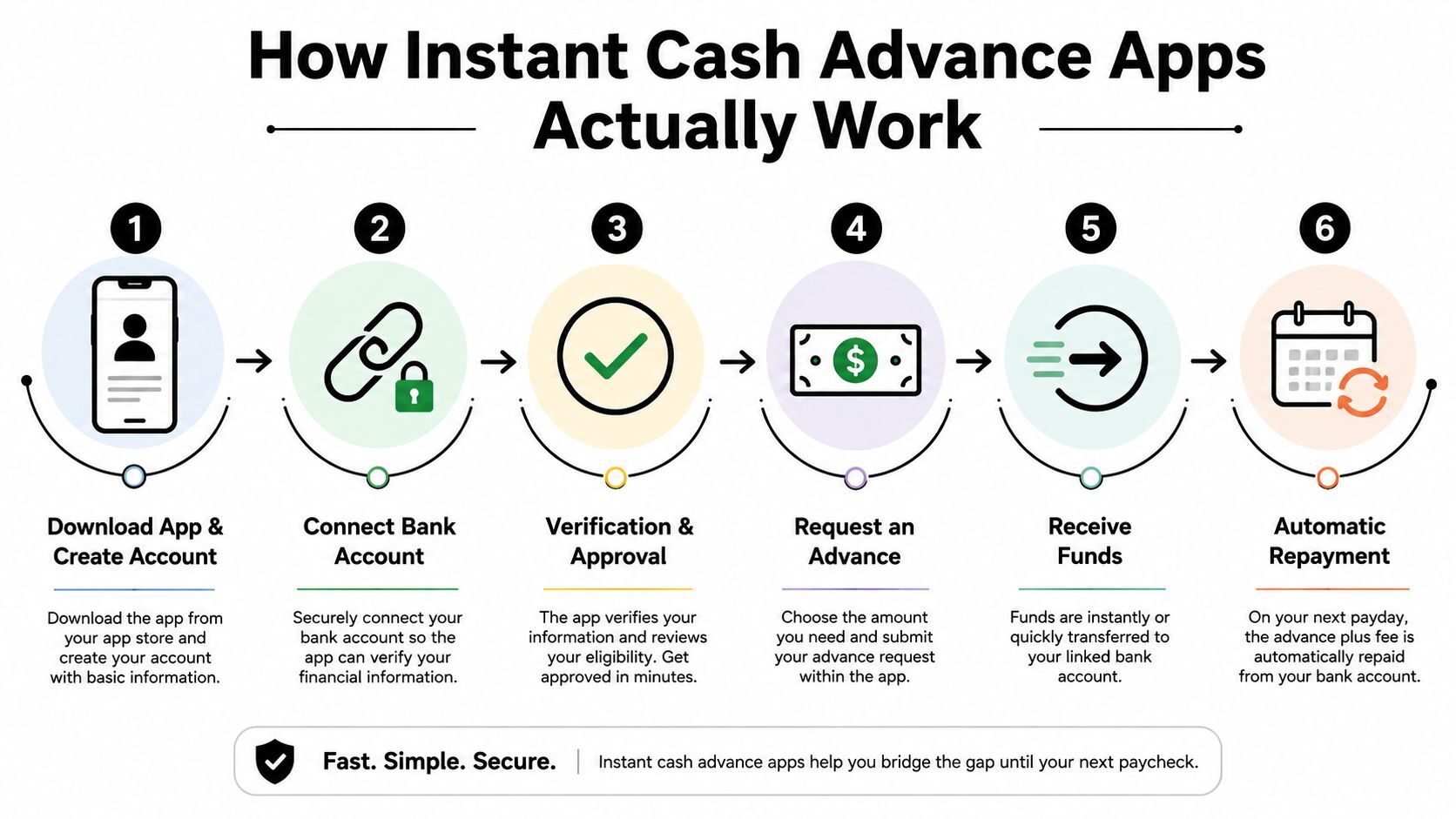
A typical instant cash advance app starts by linking your bank account, then reads your transaction history to decide whether you qualify. Platforms commonly analyze roughly 30 to 90 days of deposits, withdrawals, recurring bills, balance volatility, and paycheck regularity rather than using a traditional credit score linked-bank underwriting overview. That means the app is looking for repeated evidence that money lands predictably and that there's room to repay after bills clear.
The approval engine
The core calculation is simple, even if the app's design tries to hide it. If your direct deposit pattern is steady and your account usually has enough left after bills, the platform tends to offer more room and better terms. If your income is irregular or your balance repeatedly dips low, the app can shrink your limit or deny the request linked-bank underwriting overview.
That's why these products feel accessible to some users and frustrating to others. They aren't judging you like a credit card issuer would. They're judging cash flow.
Funding and repayment
Most apps split delivery into two tracks. Standard funding is usually slower and often free, while instant funding costs extra because you're paying for speed. Repayment typically happens through an automatic ACH debit on your next payday, which makes the product behave a lot like a payday loan even when the app markets it as earned wage access or a tip-based service.
Here's the basic cycle:
- You download the app and link your bank.
- The app checks deposits, bills, and balance patterns.
- You request an advance.
- The app shows the amount you can take.
- You pay more if you want the money immediately.
- The app pulls repayment from your account automatically on payday.
The fee design is where things get tricky. Some apps push subscriptions, others push per-use transfer fees, and many ask for tips that feel voluntary in theory but pressured in practice. The difference between a product that looks inexpensive and one that is inexpensive often comes down to how often you use it and whether you pay to speed it up.
If you want the simplest way to think about it, compare it to a payday loan with a friendlier interface. The app rebrands the same basic short-term liquidity cycle, but the repayment still comes out of your next paycheck. That distinction matters less than the actual economics.
Later in this article, I'll show you which apps keep the structure clean and which ones turn a small advance into an expensive habit.
The fastest money is rarely the cheapest money.
The True Cost of Using Cash Advance Apps
A small advance can get expensive fast. The headline pitch is usually no interest or no mandatory fees, but the actual bill is built from transfer charges, subscription charges, tips, and the chance of an overdraft when repayment hits at the wrong time. Independent and regulatory sources note that transaction-based fees commonly fall in the $1 to $5 range or about $1.99 to $2.00 per access in some EWA models, and instant access fees, tips, and overdrafts can push the price much higher than the app's marketing suggests consumer lending brief.
What actually adds up
The fee stack usually has four parts. First is the instant transfer fee. Second is the subscription, if the app requires one. Third is the tip prompt, which may be labeled optional but is built into the flow in a way that pressures many users to pay. Fourth is the overdraft hit if the repayment lands when your balance is too low.
Independent consumer research found instant-access fees ranging from $0.49 to $25 and monthly subscription fees from $1 to $19.99, with repayment still able to trigger overdraft charges hidden-costs study. For advances repaid in 7 to 14 days, the average APR was estimated at 367%, which puts these products close to payday-loan pricing hidden-costs study.
That should change how you read “small” fees. A charge that looks harmless on a phone screen becomes expensive when you use the app again and again. Frequency is what turns convenience into a recurring expense.
Why overdrafts are the real trap
The biggest hidden cost is often not the app fee itself. It is the failed repayment. If the automatic debit hits an account with too little cash, you can get hit with a bank overdraft fee on top of whatever you already paid for the advance. Consumer advocates and CFPB-related materials note examples where instant access fees and repeat overdrafts can push the effective cost of a $100 advance to $29 or more when a $25 overdraft fee is triggered consumer lending brief.
That is why “no interest” is a weak selling point. The app can still be expensive without charging interest in the conventional sense. It can extract value through access, timing, and a repayment structure that pulls money when your cash is already tight.
| Borrowing Option | Typical Fees for $100 | Effective APR | Repayment Term |
| Instant cash advance app | Instant fee, subscription, tip, possible overdraft | Often very high when annualized, sometimes payday-loan level | Usually next payday or within days |
| Payday loan | High fee, often flat or percentage-based | Very high | Usually next payday |
| Credit card cash advance | Cash advance fee plus interest | High, but varies by issuer | Revolving |
| Personal installment loan | Usually lower upfront fee, interest-based | Typically lower than cash-advance-style products | Weeks to months |
A realistic user who takes multiple small advances in a month can pay far more than expected, even before an overdraft shows up. That is the part most app marketing leaves out. It focuses on the advance, not the cost of needing the advance again.
Use these apps sparingly, and only when the math is clear. If you are taking repeated advances, you are not using a convenience tool anymore, you are financing a cash-flow problem at a bad rate.
How Gerald Technologies, Inc. Can Help
Gerald Technologies, Inc. is worth looking at because it solves a different version of the same problem. Gerald is a consumer fintech app that combines small-dollar cash advances, Buy Now Pay Later purchasing, prepaid mobile service, rewards, and an in-app essentials store into one system. If your shortfall is tied to groceries, phone service, or another recurring need, that consolidated setup can be more useful than a generic cash-advance product. The company's own overview is available at Gerald's instant cash advance app.
Where it fits
Gerald's cash advances are designed around paycheck timing, with repayment on payday and no interest, fees, or late charges on eligible advances. It also offers BNPL for household essentials through Cornerstore and prepaid mobile options through Cranberry Mobile, including eSIM delivery on established networks. That mix matters if your problem isn't just cash, but a short-term gap in necessities.
The standout advantage is practical, not flashy. You can move from advance to essentials to mobile service inside one app, which reduces the number of separate bills you're juggling. For someone who keeps using cash advance apps because one utility or phone bill keeps landing at the wrong time, that can be a cleaner workflow than bouncing between multiple providers.
When Gerald makes sense
Gerald fits best if you want a system built around essentials instead of pure cash extraction. It's also a decent fit if you prefer a platform that doesn't rely on traditional credit checks, since eligibility comes from income and employment signals plus linked-account history. The trade-off is that this kind of ecosystem works best for people whose needs align with the app's store and mobile-service model.
One caution, though. A bundled product can still become a dependency if you use it to cover every shortfall. The right question isn't whether the app is more polished than a payday lender. It's whether the structure reduces your total out-of-pocket cost and keeps you from paying for the same emergency twice.
If your main problem is fragmented essentials spending and you want an all-in-one tool with no-interest cash advances, Gerald is a credible option to compare. If your problem is broader cash strain, you still need a plan that lowers future borrowing, not just a better-looking app.
Security Privacy and Regulatory Gaps
The comforting story around these apps is that they're safer than payday loans. That's only partly true, and sometimes not true at all. Many platforms operate in gray areas by labeling charges as tips, donations, or access fees, which can weaken the consumer protections that apply to more traditional lenders.
Why the rules are uneven
A lot of instant cash advance apps sit between banking, lending, and payment services. That means the regulatory playbook can be patchy, especially when an app tries to avoid being treated like a standard loan product. In practice, that can leave users with less clarity on dispute rights, fee disclosures, and what happens if a repayment goes wrong.
There's also privacy exposure. These apps need access to bank credentials and transaction histories, and some ask for more data than a simple advance should require. If that data is mishandled, shared broadly, or breached, the damage isn't theoretical. Once you connect financial accounts, you're handing over a detailed picture of how you live.
The risk of weak access control isn't abstract either. The internet has already seen major account exposure events, including the breach described in this Internet Archive account incident report, which is a useful reminder that large credential stores and broad access permissions deserve skepticism.
What to verify before trusting an app
Before you link anything, check whether the app explains its fee structure in plain language, not just in marketing copy. Look for a clear policy on data retention, connected-account permissions, and whether repayment happens through automatic ACH pulls or manual action. If the app won't spell that out, walk away.

Decision rule: Convenience is not a substitute for transparency. If you can't tell how an app makes money, you shouldn't trust it with your bank link.
The right frame is simple. Traditional payday loans are openly expensive. Cash advance apps can be less obvious, but hidden access fees, tipping design, and repayment timing can make them just as punishing for the wrong user. Before you sign up, assume the app is collecting more than money, then verify exactly what it's collecting and why.
How to Choose a Safe Cash Advance App
A safe choice starts with rejecting the shiny headline. The core question is which app gives you money with the clearest terms and the least chance of surprise damage to your budget.
The checklist that matters
Start with licensing. If an app acts like a lender in your state, verify whether it is registered or operating through a partner that is. Then read the fee schedule line by line, including instant transfer costs, membership fees, and any required tipping or subscription layer.
A polished interface can hide a messy cost structure. If the app pushes you hard toward a tip or buries the optional choice, treat that as a warning sign.
Privacy and repayment deserve equal attention
Check whether the app uses read-only bank access or broader permissions, and look for a written retention policy that says how long your data stays on file. Also confirm how repayment works. Automatic ACH debits are common, but you should know exactly when they happen and what occurs if your account is short.
Watch for these red flags:
- Opaque fee screens: If the app will not show the total before you tap confirm, skip it.
- Pressure-based tipping: If “optional” feels mandatory, the design is doing work the disclosure is not.
- Penalty-heavy repayment: Any app that punishes insufficient funds with extra charges can turn a small advance into a recurring problem.
- Confusing account links: If the permissions feel broader than needed, stop before connecting.
- Inflated review pages: Read complaints, not just star ratings. Real users often mention overdrafts, recurring charges, and cancellation problems faster than polished marketing does.
I'd rather use an app that under-promises and charges transparently than one that advertises a big limit while hiding the actual terms. That matters even more if your cash buffer is thin, because the repayment method can matter more than the advance itself.

If you want a quick screen test, save this rule. Clear fees, narrow permissions, obvious repayment timing, and no pressure to tip. Anything less is a weak product dressed up as a convenience app.
APKUpdater-style app management guidance is a useful reminder that good mobile habits start with control, not impulse. Applying the same scrutiny to financial apps means verifying permissions before linking your bank, not just updating your APKs.
Better Alternatives and Smart Consumer Actions
If an app charges you a fast-funding fee, pushes subscriptions, asks for tips, and still risks overdraft charges at repayment, it is not cheap money. It is expensive short-term cash with a friendly interface. Stop treating these apps like regular budgeting tools. They are emergency bridges, and if you keep using them, the core problem is cash flow, not access.
Better options to compare
A credit union payday alternative loan is usually cleaner than an app when you qualify. Employer-sponsored earned wage access can also work if your workplace offers it, because the access model is often simpler than a consumer app with layered charges. A 0% APR credit card can be a better fit if you have discipline and a real repayment plan, since you are not paying to reach your own paycheck.
Non-borrowing moves matter too. Build a tiny buffer with automatic transfers, even if the amount looks small. Ask creditors to move due dates so bills hit after payday instead of before it. Use budgeting tools to spot the gap before you reach for another advance.
Make the cost visible
Start by auditing what you have already paid. If you have used an app for months, total up transfer fees, subscriptions, tips, and any overdraft charges tied to repayment. Put the full amount in one place. That number usually changes behavior faster than a warning ever will.
Then set a reduction target. Use the app less next month, then less again the month after. Move whatever you would have spent on fees into a small buffer account. The point is simple, buy yourself out of the cycle one avoided fee at a time.
| Option | Typical Cost | Access Speed | Consumer Protections |
| Cash advance app | Variable fees, tips, possible subscription | Very fast | Mixed, depends on app design |
| Credit union PAL | Usually lower-cost than app-based borrowing | Slower than instant | Stronger, more traditional lending oversight |
| Employer EWA | Often lower or no consumer-facing fee | Fast if available | Depends on employer and provider |
| 0% APR credit card | No interest if paid on time | Fast if already approved | Credit-card dispute rights and structured terms |
If you want a practical screen, compare total cost, not just waiting time. A small buffer, a later bill date, and a cheaper borrowing option will do more for your budget than chasing the next app that advertises instant money.
NeoTeo readers who want practical, no-nonsense money advice should also follow consumer protection updates from California, including new California law requires clear labeling of license purchases in video games and digital media, because the same habit applies here, read the terms before you hand over your bank access.


