
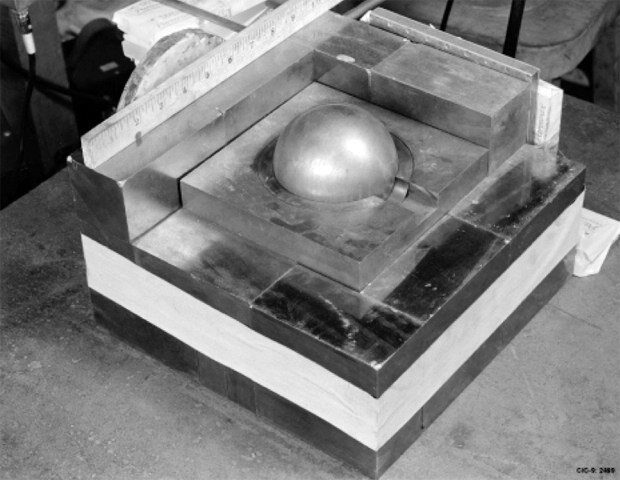
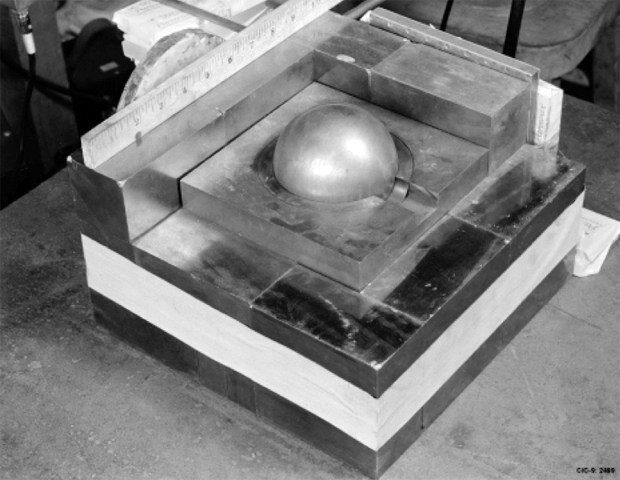
Harry K. Daghlian and Louis Alexander Slotin were part of the scientific team that during the 1940s developed the first atomic bombs as part of the Manhattan Project. The former worked as an assistant to the latter, and both lost their lives in two separate accidents at the Los Alamos laboratories. In both cases, the scientists were working with a core later nicknamed the “Demon Core” and used in the ABLE nuclear test within Operation Crossroads.
After World War II, in which the US military vaporized some 210,000 people in Nagasaki and Hiroshima, scientists in that country continued working on the development of atomic bombs. The world was heading toward what would later be known as the Cold War, and the availability of such weapons was absolutely indispensable to the generals of the time. This is how the facilities built in New Mexico for the Manhattan Project, conveniently expanded, continued to be used for research on these devices.
Working with radioactive substances can be very dangerous, and despite all imaginable safety measures, the physicists working at Los Alamos constantly risked their lives handling the compounds used in experiments. Louis Alexander Slotin was born on December 1, 1910, in Russia, but as a child he fled the anti-Semitic pogroms of Russia with his family to Canada. Exceptionally gifted for studies, at age 16 Slotin entered the University of Manitoba, where he received the gold medal in both physics and chemistry.
He graduated in 1932 and the following year earned his Master of Science. Soon after, he obtained a position at King's College in London. Some historians claim he was part of an international brigade supporting the troops of the Second Republic in the Spanish Civil War, but others say he only traveled to Spain as a tourist. He earned a doctorate in physics and chemistry in 1936, and his doctoral thesis (“An Investigation into the Intermediate Formation of Unstable Molecules During some Chemical Reactions”) received a university prize.
In 1937 Slotin began working at the University of Chicago as a research associate. Specialized in nuclear chemistry, he was part of the team that built the first cyclotron in the western United States. His numerous articles on radiobiology led the US government to consider him indispensable for the Manhattan Project. Thus, in December 1944, after passing through the Oak Ridge National Laboratory in Oak Ridge (Tennessee), Slotin ended up at the Los Alamos National Laboratory in New Mexico. His job was to conduct criticality tests on uranium and plutonium samples.
Basically, what Slotin did was bring these materials to critical levels, very close to the point where a nuclear chain reaction would begin, to stabilize their mass. Physicist Richard Feynman called these experiments “tickling the tail of the dragon”, because they were so close to nuclear fission. His colleagues referred to Slotin as “the chief armorer of the United States”, since he was responsible for preparing the cores of nuclear bombs. “Trinity”, the first atomic bomb detonated in history, was assembled by this man.
Slotin had several assistants. One of them was Harry K. Daghlian, who would become the first death within the Manhattan Project team. In August 1945, he was conducting critical mass experiments at the Omega Site Laboratory, which depended on the Los Alamos Laboratory, when he accidentally dropped a small brick of tungsten carbide into the plutonium core that would be used in a bomb. The bricks, used as neutron reflectors, had to be placed slowly around the core. When all were in place, the assembly could “enter” a critical but controlled nuclear reaction, similar to what happens in a nuclear reactor.
Safety protocols dictated that this work could not be done by a single person, but Daghlian – working in the early hours of the morning – broke the rules and attempted to place the last tungsten carbide block. He accidentally dropped the brick, and the reaction reached the stage immediately before the supercritical phase. At that instant, a radioactive event accompanied by an intense blue ionizing glow took place. Daghlian knew he was dead, but still had the presence of mind to partially disassemble the pile of blocks and stop the reaction. He died three weeks later from acute radiation poisoning.
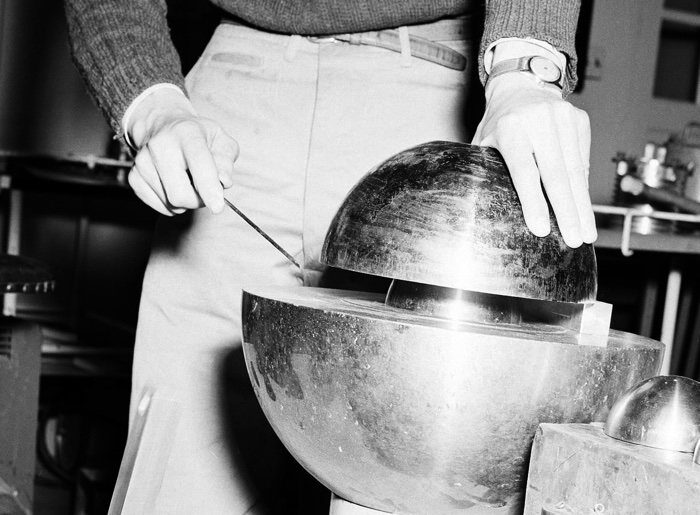
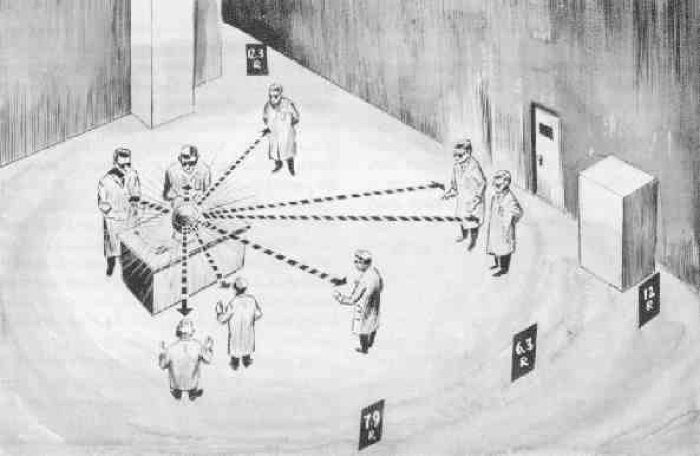
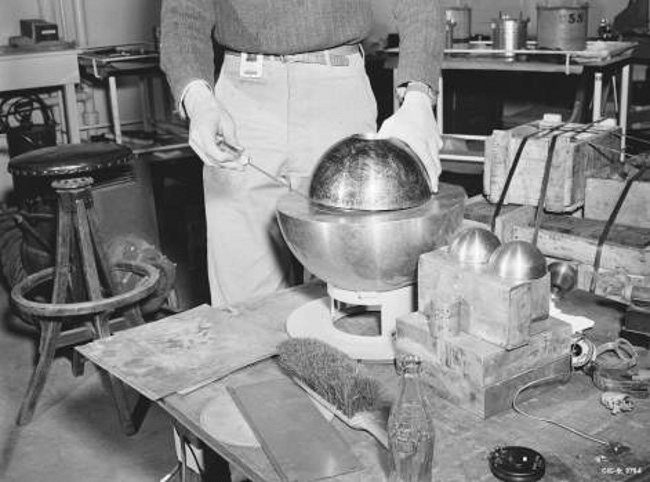
Ironically, that same core, which scientists would later nickname the “Demon Core”, would also cause the death of Louis Slotin. On May 21, 1946, Slotin was with seven other physicists working on an experiment that required placing two beryllium hemispheres around the plutonium core that had killed Daghlian. Slotin had his left hand on the upper hemisphere, keeping it separated from the other half using a screwdriver held in his right hand.
No part of the written protocol for this operation included the use of a screwdriver, but it seems that since it was work he had done many times, Louis used this tool. None of those present must have considered it a danger, as no one said a word. But in a moment of distraction, the screwdriver slipped, and the upper beryllium hemisphere fell onto the core, causing a critical reaction. Again, the blue glow associated with high-energy electromagnetic radiation emission was observed by all present, and they could feel the heat wave coming from the core. Slotin quickly lifted the hemisphere and threw it to the floor, stopping the reaction.
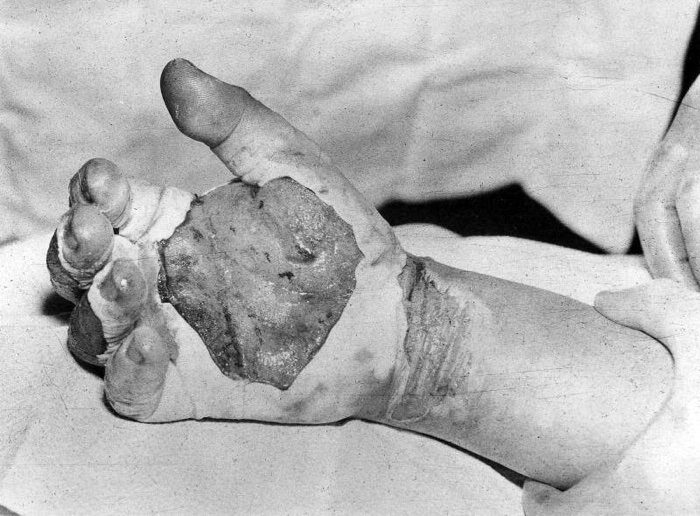
The sour taste he immediately felt in his mouth and the intense burning sensation in his left hand told Slotin that he had been exposed to a massive dose of radiation, and that for all practical purposes he was dead. Minutes later he was vomiting in the hallway, waiting to be taken to the hospital. It was determined that he had been exposed to a dose of gamma and neutron radiation close to 2,100 rems, similar to what he would have received standing 1,500 meters from where an atomic bomb was detonated.
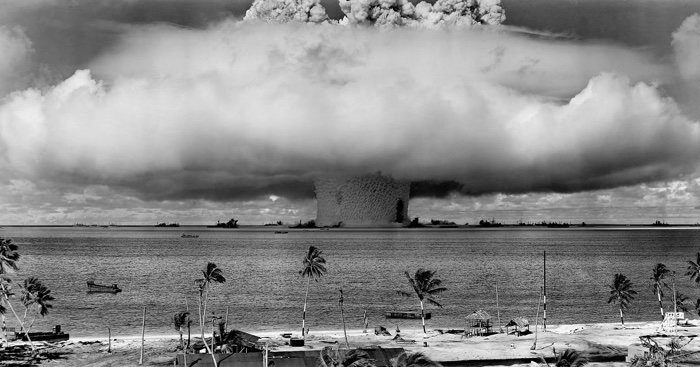
The “Demon Core” had claimed a new victim: nine days after the accident, on May 30, 1946, Slotin died. The core was detonated as part of a nuclear device called ABLE, within a series of tests called Operation Crossroads. Slotin's death led to subsequent work on fission cores being carried out using remotely controlled robotic arms.


