
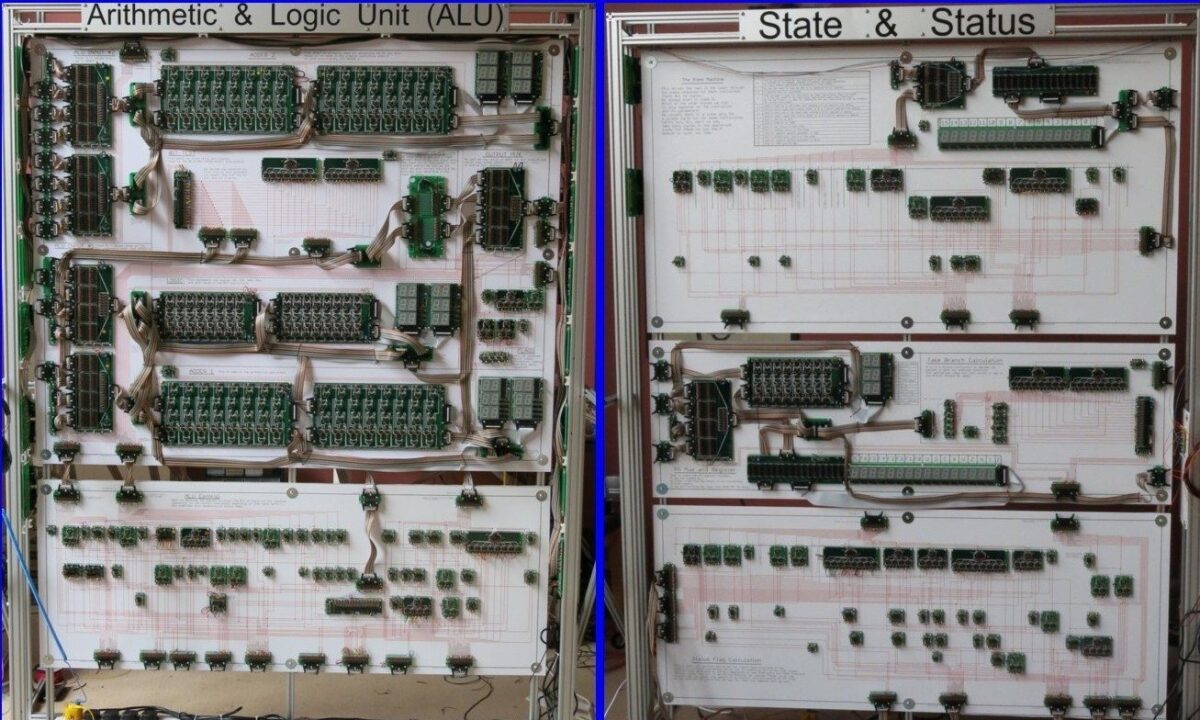
We first talked about the Mega-Processor project in June of last year. Its creator James Newman invested a considerable amount of time, money and energy, and finally declared the Mega-Processor finished, publishing a complete tour video on YouTube in the last days of June. Of course, we say tour because the design of 40,000 transistors and 10,000 LEDs occupies the walls of a living room.
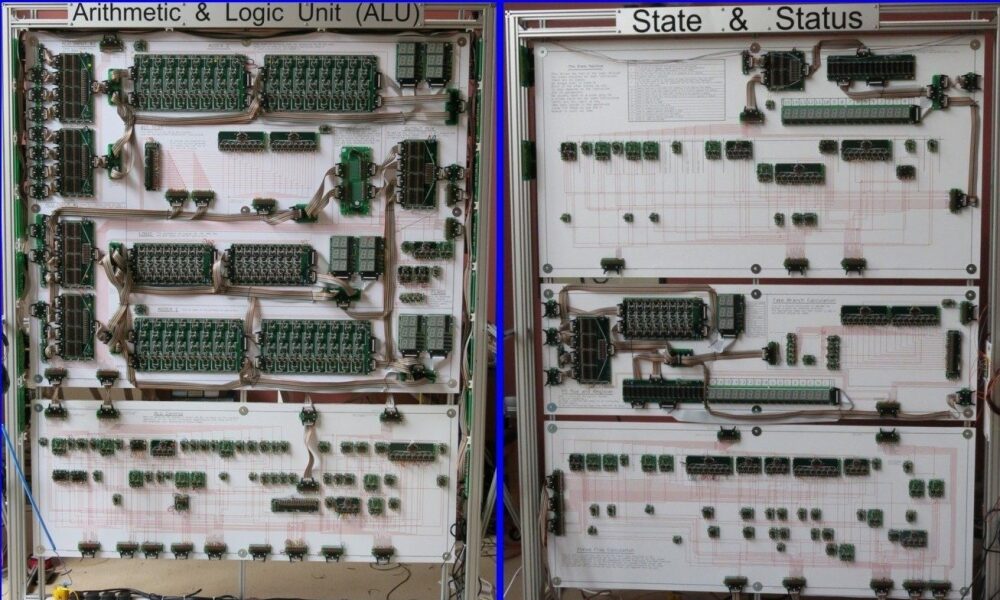
What began as a personal project has become, with much time and effort, one of the most spectacular educational exhibits in the world of computing. Today, the processor is a common component, and its evolution over the decades has allowed it to fully absorb remarkable optimizations, but beyond logic or architecture, the processor's story can be reduced to transistors. When we say that the GPU of the Nvidia GTX 1080 graphics card has 7.2 billion transistors, that gives us an idea of its capacity, but not necessarily of its operation. To achieve that, someone would need to build a processor "at human scale", installing every transistor and every interconnection, one by one.
Well, that processor exists, and it's called Mega-Processor. According to its creator James Newman, the final version has 40,000 transistors, 10,000 LEDs, measures ten meters long by two meters high, weighs half a ton, consumes a not-insignificant 500 watts of electricity, and its maximum frequency is around 20 KHz (according to the official page), although in the video he announces a speed of 8 KHz. The ability to modify the speed further helps the visualization process, a true dance of LEDs that lights up his living room. General and special process registers, arithmetic-logic unit, inputs, outputs, instruction decoding… everything that makes up the concept of "processor" is there.
If that doesn't seem enough, perhaps you'll want to know that the Mega-Processor can be programmed (after all, it works perfectly), and it even shows a Tetris clone as a demonstration in the video. Anyone interested in creating software for the Mega-Processor can access the necessary tools on the official page, and after declaring the Mega-Processor "version 1.0", we'll surely see more videos and updates from Newman. Personally, I'm very glad to see it finished. Without a doubt it has been a "one-man project", and despite the difficulties, it reached its goal.


