Time and again we come across articles about recently launched satellites that include a rather odd graphic. When visualizing an orbit, most people expect to see a straight line with the proper inclination, but instead they get something that, for lack of a better description, looks like a wave. Why do experts represent orbits that way? The real reason lies neither in the satellite nor in its orbit... but in the map of the Earth.

Recently I have been exploring several articles focused on the intention of Donald Trump's government to return to the Moon, the plans NASA has for it, and how it will affect the International Space Station... because at the end of the day, the money has to come from somewhere. One section of the press believes that the return to our only satellite is not going to happen. Considering that NASA's current budget is one of the lowest in its history, the mission will probably never go beyond simulators. Others believe that the priority should be Mars and invest the scarce available funds in that, and then there is the third option, which is to hand the International Space Station over to private hands to free up funds. Among all those texts, some images of the station appear, but one caught my attention:

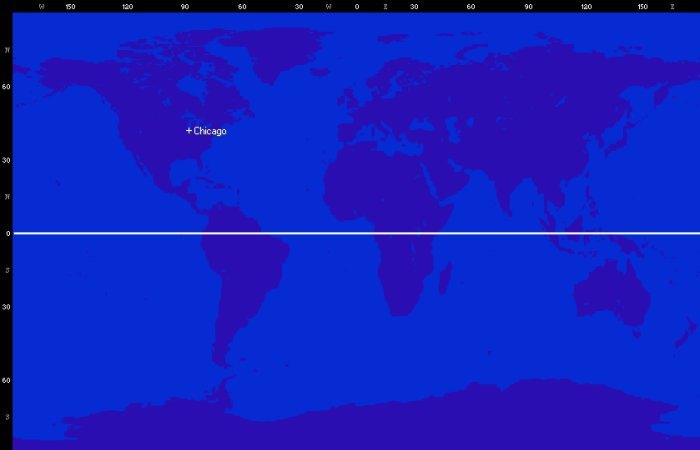
Without a doubt, that is the station's orbit. But why does it look this way? The station maintains a very stable orbit at about 400 kilometers above our heads, and there is no zig-zag about it. When exploring the orbits of other objects in space, we find that their orbit lines on the ground map are similar... and there lies the key. Orbits look like waves because they are 3D representations on a 2D map, which was modified so that the sphere of the Earth becomes a cylinder. That leads to very confusing situations (which I hope to explore later), but the most effective way to explain the orbit-wave is with a video:
Of course, there are exceptions to this situation. One arises when the satellite's orbit unfolds over the equator, and then we find more complex and exotic orbits that generate different patterns (Molniya, for example). In short, it's one more doubt cleared up, and it brings us a little closer to space.