
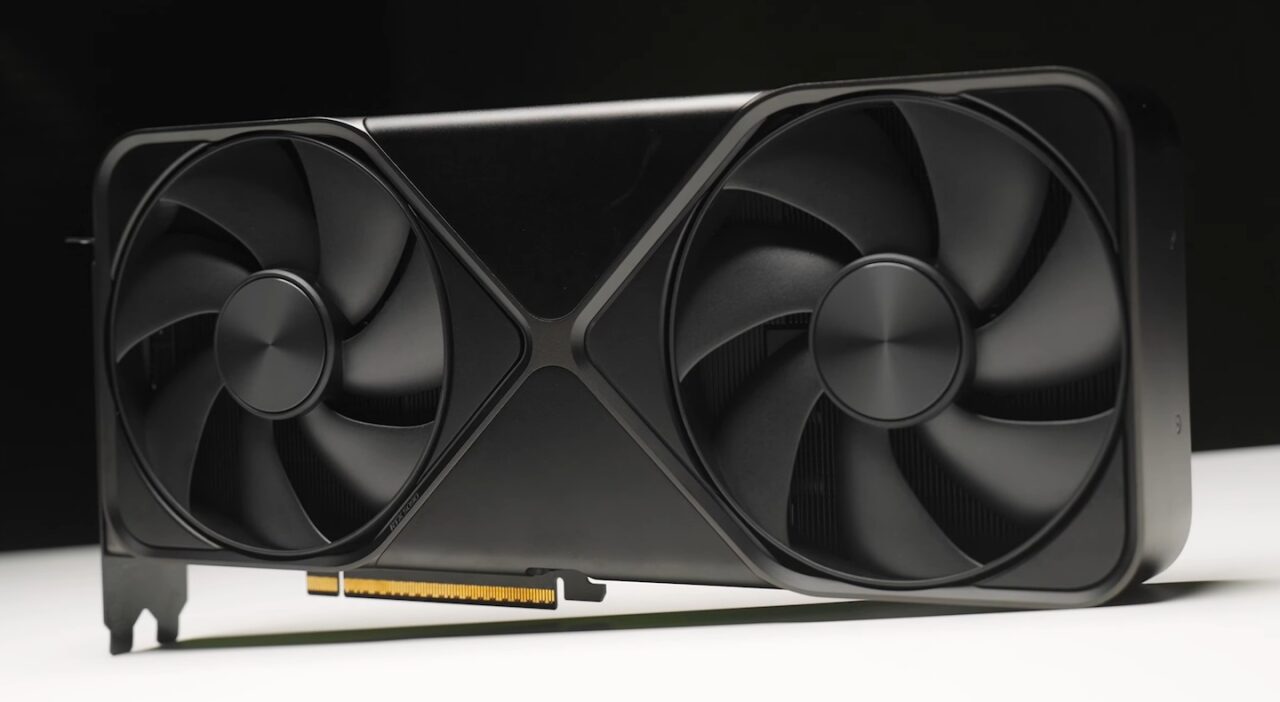
The official embargo is over, and as expected, the first GeForce RTX 5090 benchmarks have taken the web by storm. With over 20,000 CUDA cores, 32 GB of GDDR7 VRAM, a 512-bit memory bus, and a TDP that knocks on the door of 600 watts, Nvidia reminds us that it essentially has no competition in the high-end space. But a question remains: can this generational leap justify a $2,000 (!) investment in a graphics card?
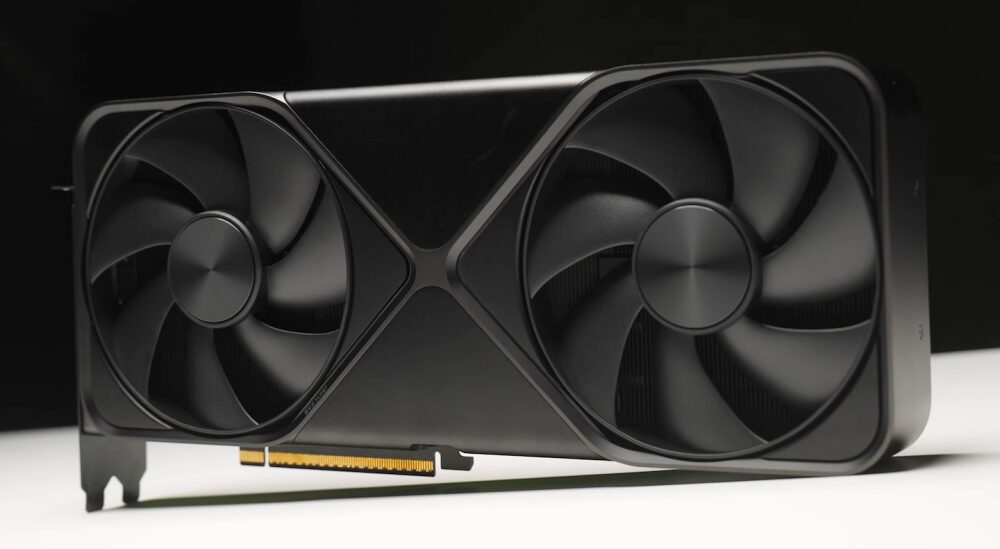
It must be acknowledged that the wave of enthusiasm for new graphics hardware is not as big as in other occasions. The only thing that moved the needle a bit was the launch of Intel's Battlemage cards (completely sold out, I might add), but the rest suggests we have entered the era of “fake cards”, since they behave like glorified upscalers with AI generators.
And yet, Nvidia introduced its GeForce RTX 5090, one of the first consumer cards on the Blackwell architecture. Its specs are truly impressive (92 billion transistors, 21,760 CUDA cores, 32 GB of GDDR7 VRAM, and a 512-bit bus), but we all know the truth is revealed through benchmarks. What exactly can it do?
GeForce RTX 5090: The New Queen… by Pure Brute Force
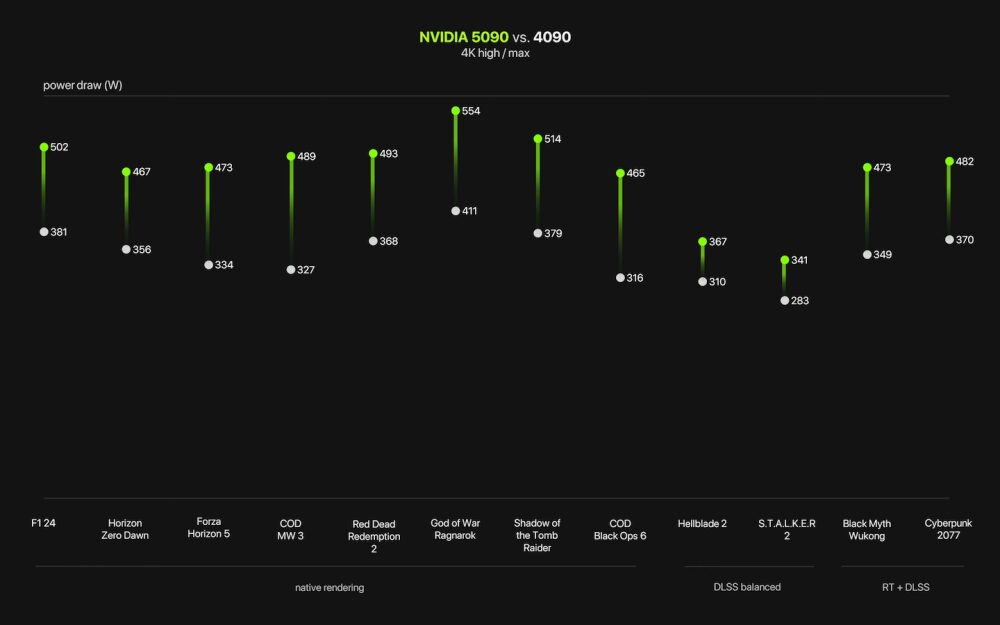
The reviews from major YouTubers are excellent, but if you want an abridged version, you definitely have to check out the Optimum channel. Under normal rasterization conditions and some cases of ray tracing, the GeForce RTX 5090 increases performance by 27 percent on average when compared to a 4090, although there are cases where it registers a jump of over 40 percent. The “problem” is that this improvement is paid for with power consumption: Nvidia's efficiency optimizations are basically a myth.
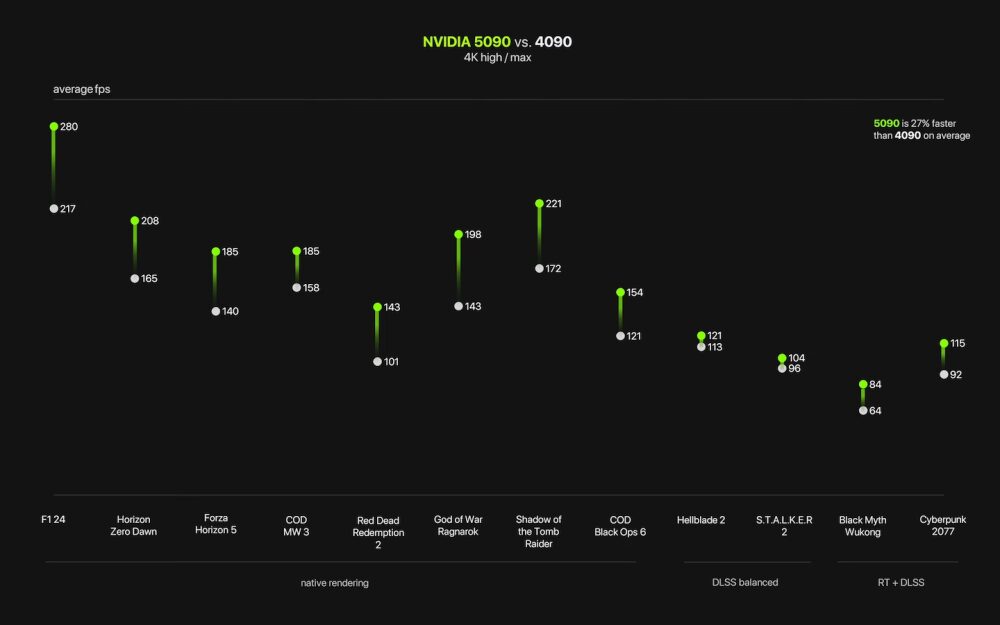
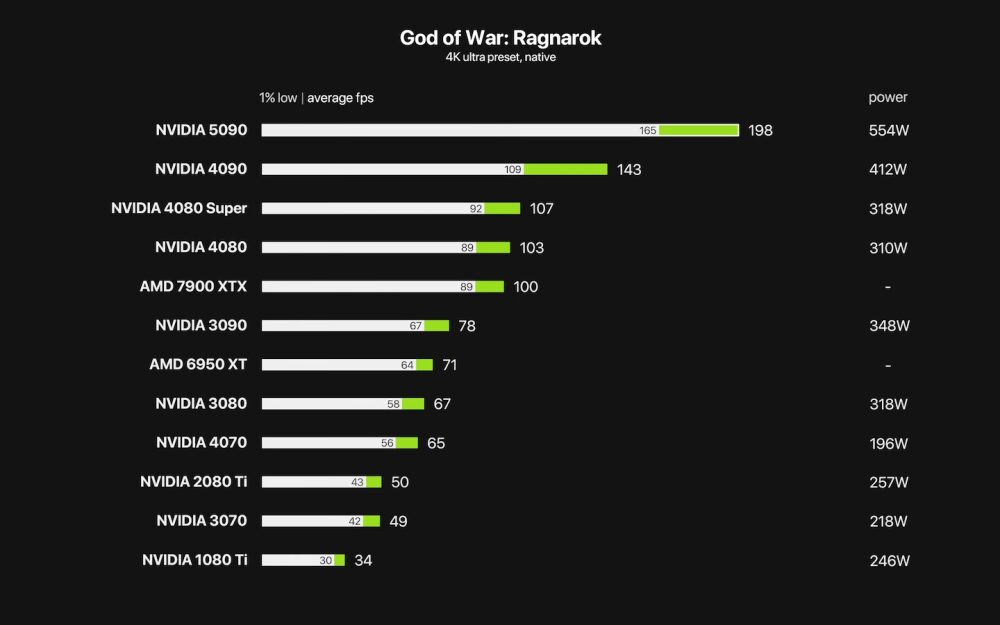
Optimum presents two examples, Forza Horizon 5 and God of War: Ragnarök. Forza jumps from 140 FPS to 185, a 32 percent increase (always compared to the 4090). But if we look closely at its consumption… it increases by 42 percent. God of War is in a similar situation: The fact that the 5090 hits near 200 FPS in 4K Ultra native deserves to be highlighted, but it stays very close to the 575W ceiling. Needless to say, 1000W power supplies are no longer a luxury. With this kind of hardware, they are a necessity.
So, what does Nvidia want from us? Obviously, to enable frame generation. The new “Multi-FrameGen” mode can multiply additional frames by four. In essence, the idea is for the player to crank up graphics and ray tracing to the max, apply a lock of 60 FPS, then activate frame generation at 4X, a condition designed for 240 Hz monitors. The trained eye won't take long to notice artifacts, and latency isn't going anywhere, but it's not that bad either, at least in single-player games.
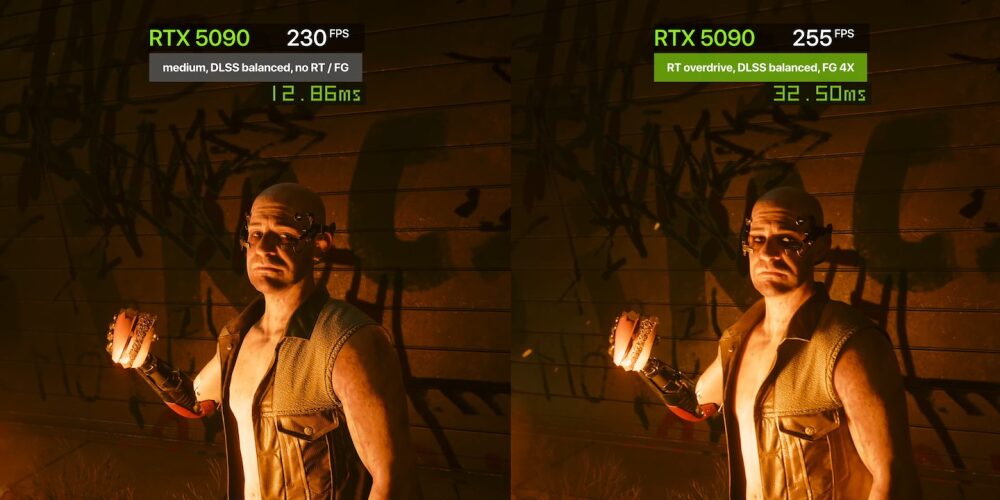
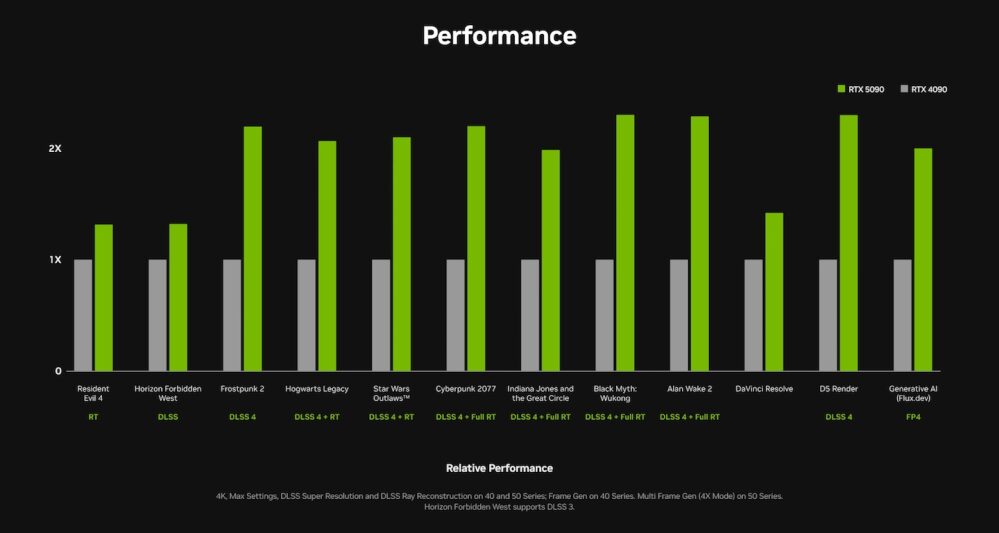
In summary, the GeForce RTX 5090 is the fastest and most powerful graphics card on the market, but there are no miracles here. Almost all of Nvidia's marketing relies on “optimized” conditions with frame generation, which is equivalent to comparing apples to photos of apples. And nothing is going to change: Those who can invest more than $2,000 in hardware (and I say “more” because that published “USD 1,999” is going to fly out the window) will do so without thinking twice, but those who already have a 4090 will probably take it very calmly. Moreover, some are already claiming that this card should have been a “4090 Ti”, and I think they are right.


