
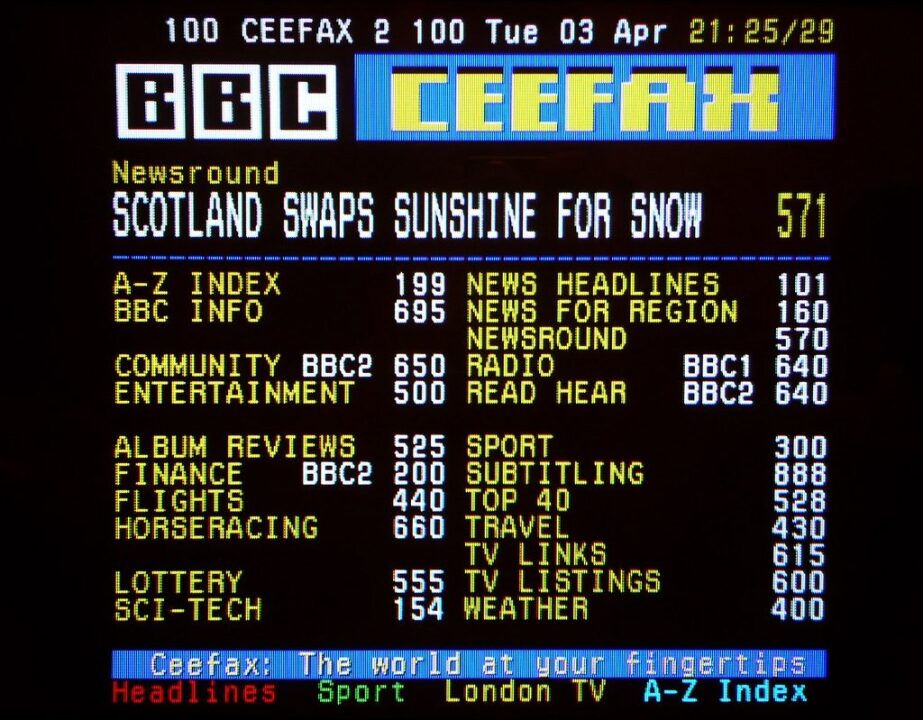
The year was 1974. Watergate was shaking the United States, and the great Muhammad Ali had just knocked out George Foreman in eight rounds, but between those two events something else had happened: the birth of CEEFAX.
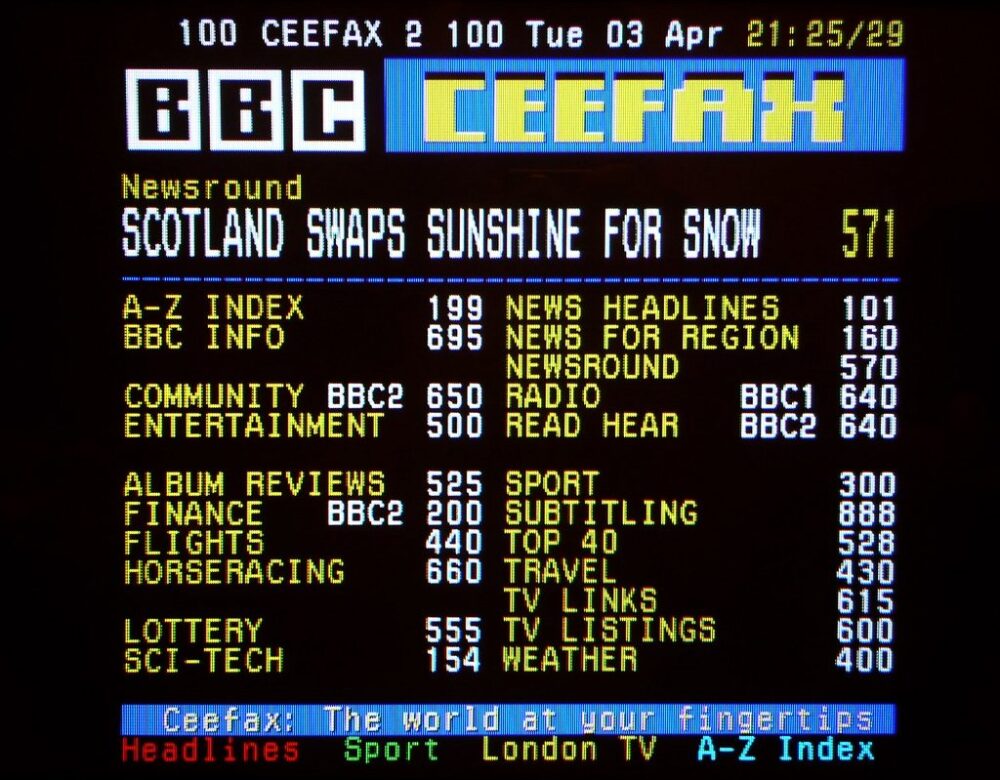
What is CEEFAX and how was it born?
It was the world's first teletext service, created by the BBC to present essential data such as agricultural news and stock market quotes on the screens of millions of Britons. CEEFAX worked for 38 years until the analog switch-off in 2012, a striking example of stability and robustness, even in the most extreme situations.
Several sources indicate that the mastermind behind the teletext concept was John Adams, a Philips engineer and lead designer for VDUs ("Visual Display Units", monitors). Adams created his prototype in 1971, based on the vertical interval or VBLANK, and presenting a not inconsiderable 24 rows of text with 40 characters each.
BBC test transmissions ran from 1972 to 1974, a period in which the service also received its official name: CEEFAX, a variant of "see facts". CEEFAX formally began operations on September 23, 1974, with just one editor, Colin McIntyre, but later added a whole team of journalists with the goal of keeping viewers informed and up to date.
(Editor's note: Yes, it's an hour and a quarter of video, don't hesitate to skip ahead.)
Back then, those responsible for feeding new information to CEEFAX had to sit in front of a terminal and create a punched tape before they could publish the "pages" and send them to the screens. There was no error correction of any kind, and if an editor had made a slip in their writing, they were forced to start from the beginning.
Naturally, not all televisions were compatible with CEEFAX in its early years, but the market responded almost immediately, integrating the necessary technology into new units. CEEFAX became much more than an information platform. Despite its limitations, it managed to introduce a certain interactive component to television, transmitting recipes that cooking programs had shared minutes earlier, or reporting on sports events as they took place.
How did users access CEEFAX?
In essence, each page had a code, and the viewer entered it using the remote control of their television. If a news item took (for example) four pages, there was a chance that a person might tune in while the transmission was on page two, meaning they had to wait for it to return to page one.
With more than 38 years behind it, CEEFAX's story ended on October 23, 2012, accompanying the analog switch-off in Northern Ireland. The direct replacement for CEEFAX is the BBC Red Button system, with all the advantages associated with digital television, though without that particular "warmth".


