
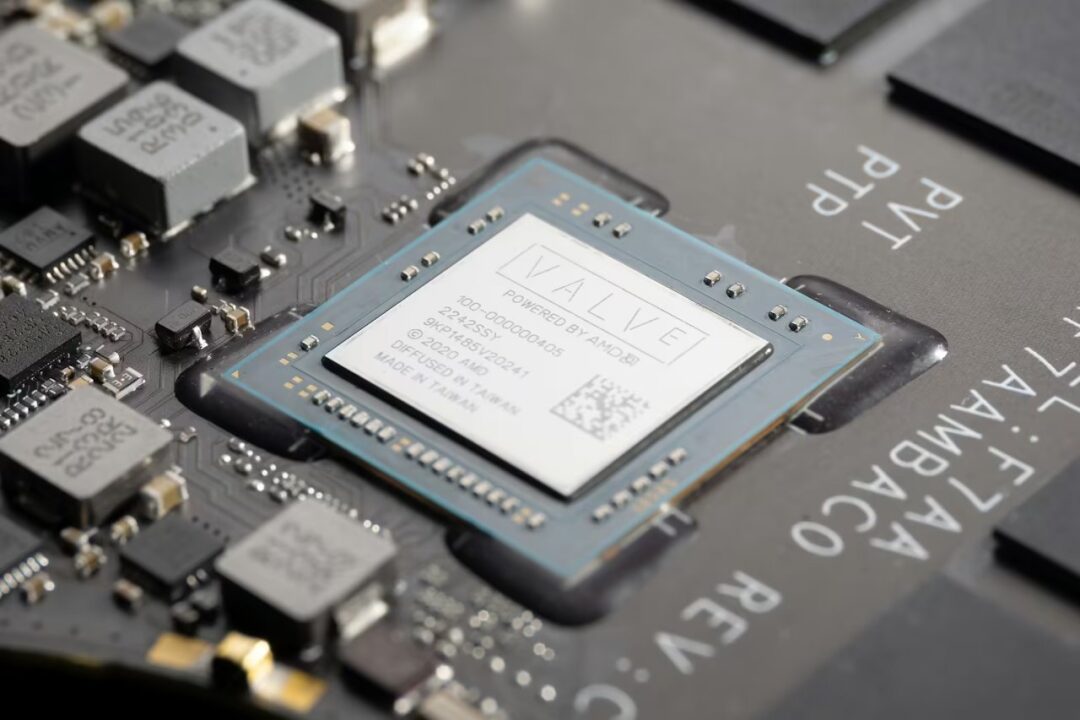
The popularity of the Steam Deck is at its peak. The number of available accessories is impressive, its compatibility keeps gaining ground, and its most important competitors fail to fully capture users' attention. The next step for Valve is to launch a more powerful version of the console, but its current hardware remains interesting, and thanks to the video by High Yield, today we can learn even the smallest detail of its APU, the AMD Van Gogh.
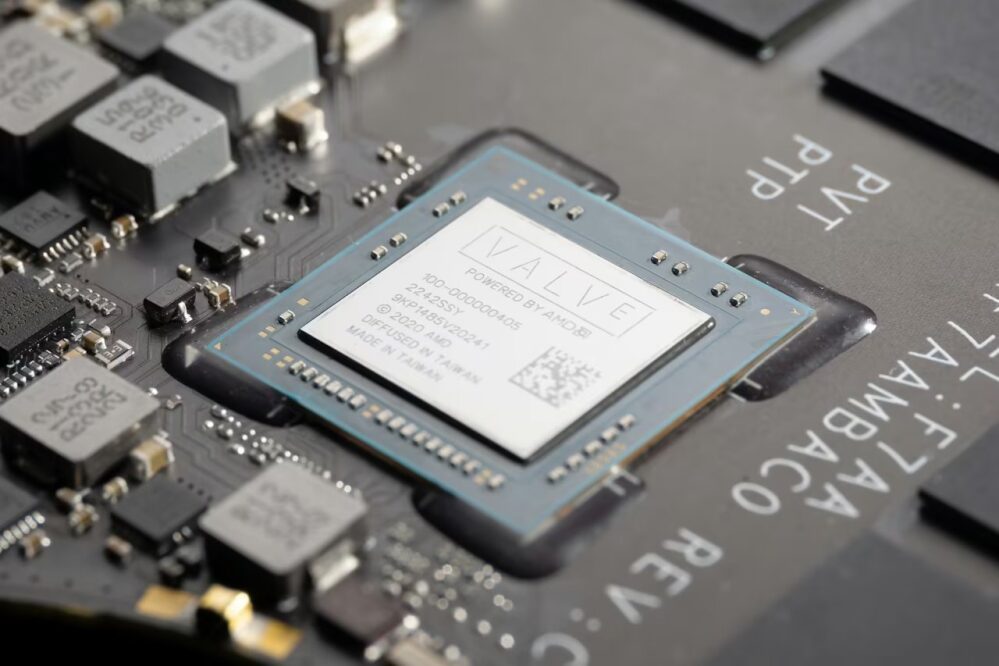
A quick visit to ProtonDB confirms that there are more than 4,300 games verified for the Steam Deck console. GTA V, Elden Ring, Skyrim, God of War... there are many heavyweights on that list, and with minimal adjustments they can provide a definitely acceptable experience. The best part is that all this happens on Linux, and the possibility of retiring Windows as a gaming platform is getting closer.
But none of this works without decent hardware in the background, and Valve selected a very interesting configuration for its system. Officially, the Steam Deck has an AMD Van Gogh APU (code name Aerith at Valve) with four cores and eight threads, at a frequency that oscillates between 2.4 and 3.5 GHz. To this are added eight RDNA 2 graphics cores at 1.6 GHz, and 16 GB of quad-channel LPDDR5 memory. Without a doubt, the APU is the most important thing of the whole console, and the video published by High Yield on YouTube allows us to know it with an extraordinary level of detail.
The Steam Deck APU
One aspect to highlight of the AMD Van Gogh is that none of this would be possible without the fabulous images of Fritzchens Fritz, probably one of the best silicon photographers on the Web. In the upper left we find four symmetric blocks, very close to the edge. These modules represent the physical layer of the LPDDR5 interface. Each block equals 32 bits, and configured in quad-channel they produce a 128-bit interface. The memory controller is just below, and its distance is essential. To the right (although High Yield cannot assure it) we see the Video Core Next block, in charge of AV1 encoding/decoding.
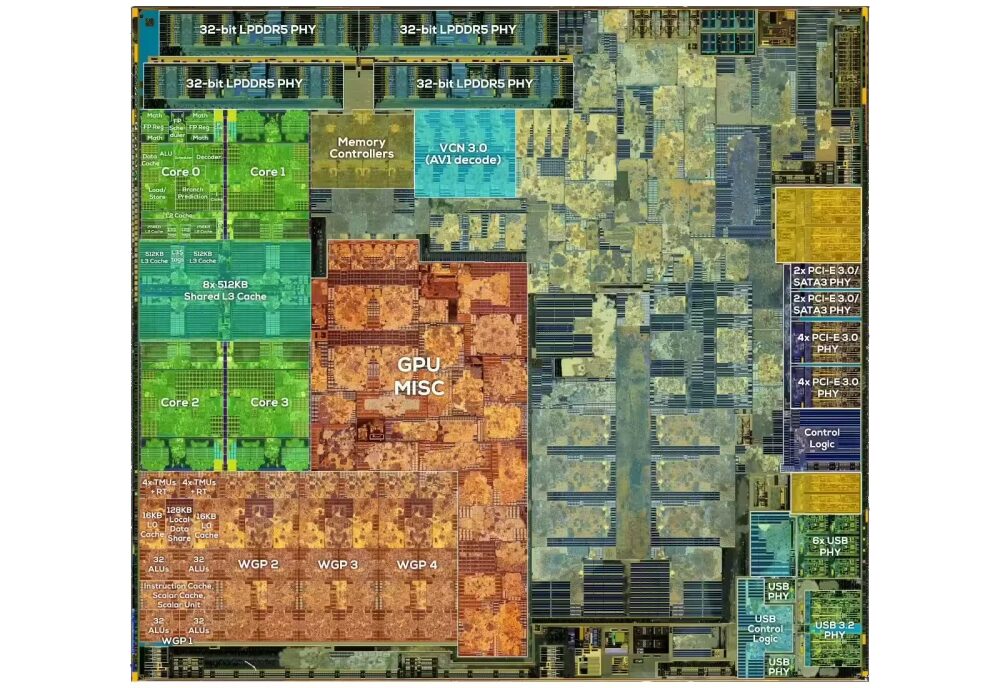
Below the CPU are the eight cores of the integrated GPU. If they seem four at first glance, it is not an error: The cores are contained in four structures called Workgroups, which also store four blocks of 32 arithmetic-logic units, and another two blocks of four Texture Mapping units, which include a pinch of ray tracing. That's right: The Steam Deck can do ray tracing in a limited capacity.
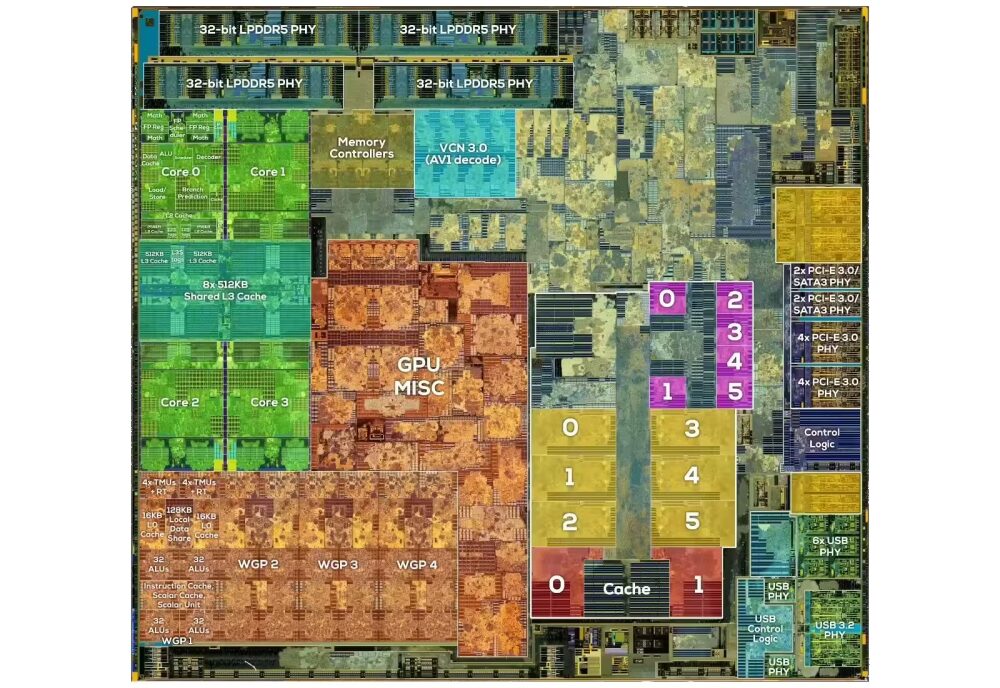
The “great mystery” of the APU occupies just over 13 percent of its surface: There appear 14 additional cores that the system does not use. As expected, the Internet went into “detective mode”, and quickly determined that they are cores for a visual processing engine. The available information suggests that the Steam Deck's APU is the same hardware used by the Magic Leap 2 augmented reality glasses.
That means that with extra optimization (the APU already received a die shrink in the OLED version) and all that freed space, the Steam Deck of the future should not have difficulties in offering superior performance.
Sources: High Yield, Boiling Steam
Images: Fritzchens Fritz on Flickr


